¿Sabías que en México miles de personas dependen de la donación de sangre para vivir?
La donación significa:
Salvar vidas: La sangre donada se utiliza para transfundir a pacientes con enfermedades como leucemia, anemia, hemofilia y cáncer, así como a personas que pasaron por accidentes y cirugías urgentes. Cada donación de sangre puede salvar hasta tres vidas.
Mejorar la salud: La donación de sangre también tiene beneficios para el donante, como reducir el riesgo de enfermedades cardíacas y algunos tipos de cáncer. Además, ayuda a mantener niveles saludables de hierro en la sangre y promueve la renovación de células sanguíneas.
Un acto de altruismo: Donar sangre es un acto de amor y solidaridad que puede tener un impacto significativo en la vida de otras personas. Es una forma sencilla de hacer una gran diferencia en el mundo. No esperes a que un ser querido lo necesite: dona para que cualquier persona que lo necesite pueda tener una esperanza de vida.
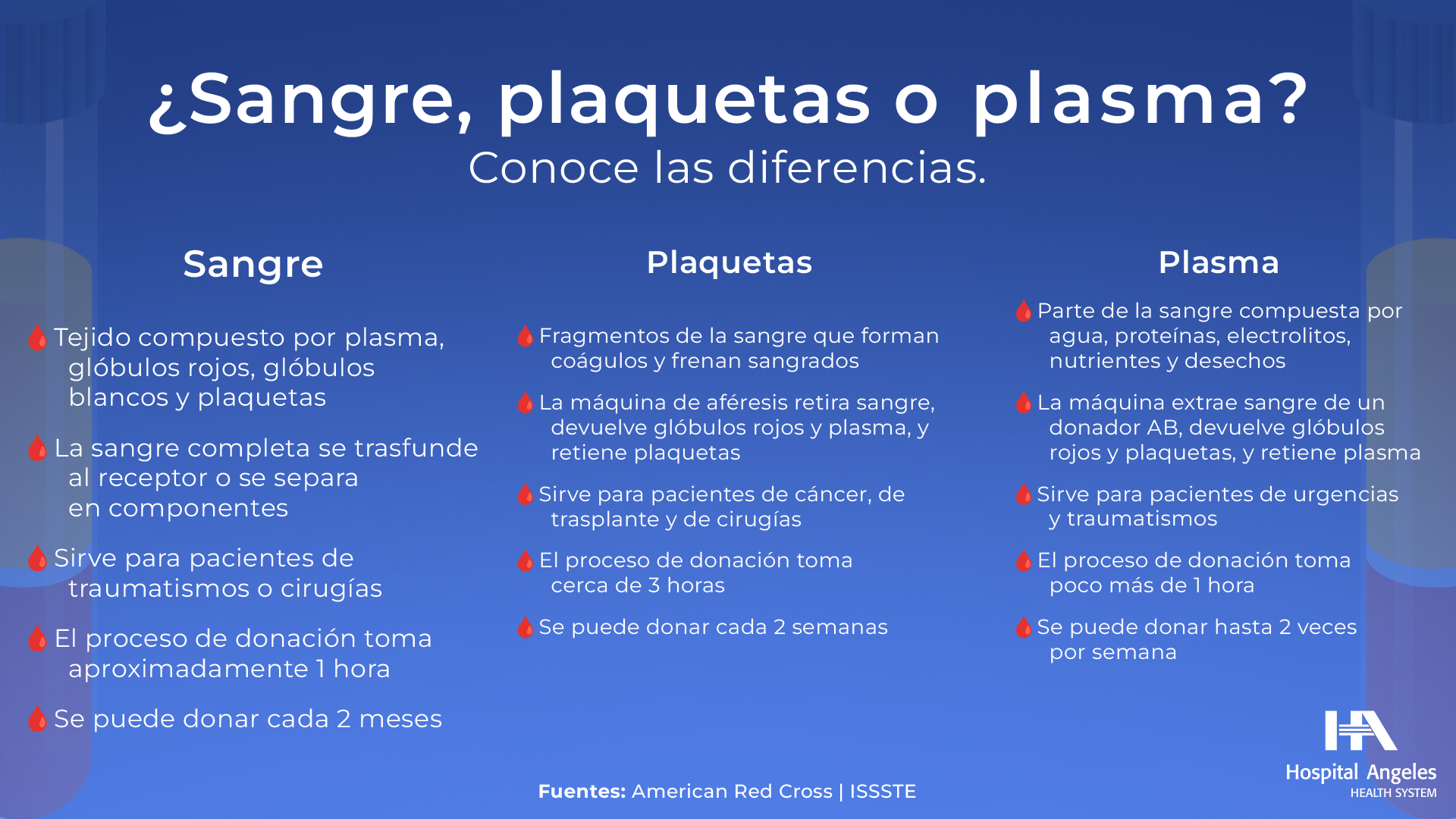
Types of donations
Ubica el banco de sangre más cercano a ti.
Stages of the donation process:
Identificación: Se realiza con una credencial oficial vigente (INE, Pasaporte o Cédula Profesional). En caso de no traer alguna de éstas, no se puede llevar a cabo la donación.
Evaluación clínica: Se realiza previa a la donación y consiste en un interrogatorio y exploración física; una vez concluida, deberá ser firmada por ti y el médico que la realizó.
La evaluación de laboratorio sucede en dos fases:
Fase 1. Previo a la donación. Consiste en la medición de hemoglobina y hematocrito para determinar, en ese momento, si se continúa con el proceso de donación.
Fase 2. La sangre donada se procesa y fracciona. Se realizan análisis para identificar el grupo sanguíneo, factor Rh y la detección de anticuerpos para sífilis, hepatitis B y C, VIH, enfermedad de Chagas y aquellas determinaciones que la Autoridad o el Banco de Sangre consideren necesarias.
Autoexclusión: Si después de contestar unas sencillas preguntas sobre tu estilo de vida y prácticas sexuales decides que tu sangre no es apta para ser donada, o el médico detecta ambigüedad en sus respuestas, ésta se desechará de acuerdo a lo que establece la normatividad vigente. El consentimiento informado para donar es uno de los requisitos legales más importantes para poder llevar a cabo la donación de sangre, por lo cual te pedimos que lo leas detalladamente. Si tienes alguna pregunta, pídele al médico que te la aclare.
El Banco de Sangre tiene la obligación de informarte si algunos de los resultados de tus análisis ponen de manifiesto cualquier anomalía importante para tu salud. La detección de un resultado positivo en alguna de las enfermedades transmisibles por la sangre supondrá la exclusión como donante, la destrucción de los productos obtenidos de tu donación y la notificación a la Autoridad Sanitaria de los resultados. Toda tu información será manejada conforme a la Ley de Protección de Datos Personales.
Requisitos para ser donador de sangre
🩸 Ser mayor de 18 años y menor de 65 años.
🩸 Pesar mínimo 50 kg y medir 1.50 m.
🩸 Ayuno mínimo de 4 horas.
🩸 En caso de presentar malestar general o cualquier otro síntoma (dolor, fiebre, cansancio, etc.), se deberá posponer la donación.
🩸 No estar tomando antibióticos. En caso de haberlos consumido, dejar pasar un lapso de 7 días para realizar la donación.
🩸 Si en este momento te encuentras tomando algún medicamento, te solicitamos lo informes al médico que te realizará la valoración para saber si continúa la donación.
🩸 No haber ingerido bebidas alcohólicas mínimo 72 horas previas a la donación.
🩸 No usar drogas intravenosas o estar bajo efectos de intoxicación por alcohol, narcóticos, marihuana, inhalantes o cualquier estupefaciente.
🩸 No estar embarazada o en periodo de lactancia.
🩸 No haberse realizado tatuajes, piercings o acupuntura en un periodo de 12 meses.
Current regulations establish clear and specific criteria for when you are ineligible to donate blood—either temporarily or permanently—which are part of the clinical evaluation and will be discussed with you.
Recuerda notificar al Banco de Sangre sobre cualquier tipo de reacción posterior a la donación.
Ahora que ya conoces todos los detalles, ¿te animas a donar sangre? Recuerda que lo que para ti son unas horas de incomodidad, para tres personas y sus familias significa un regalo para toda la vida.