The Hospital Angeles Blood Bank Hospital Angeles reliable and safe, helping to save lives with our state-of-the-art infrastructure and specialized medical equipment.
 Vialidad de la Barranca (no number), Hacienda de las Palmas, 52763 Huixquilucan, Mexico
 +52 55 5246 5000
Ext. 5072
+52 55 5246 5000
Ext. 5072
 Monday through Sunday, 8:00 a.m. to 7:30 p.m.
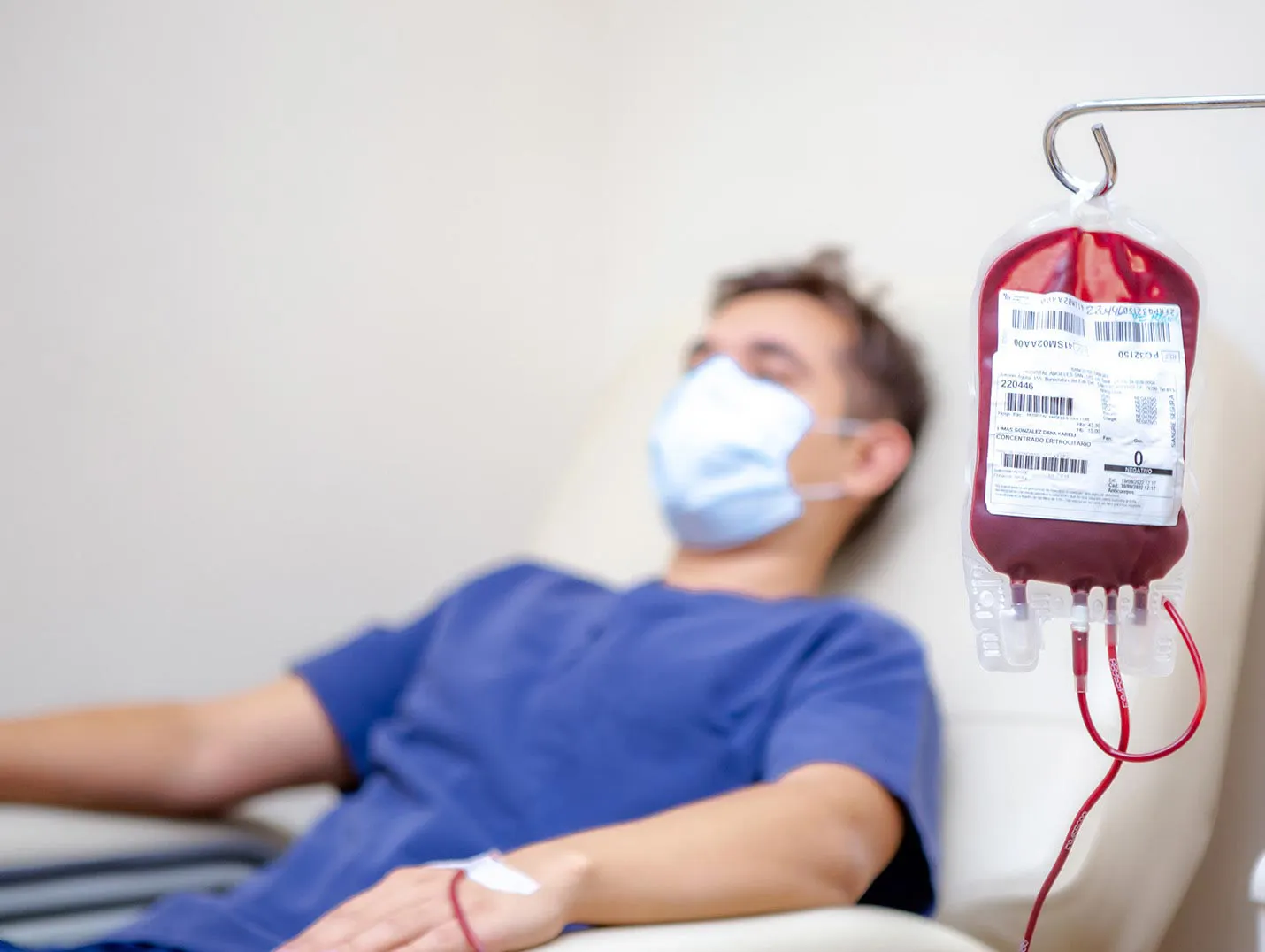
At the Blood Bank of Hospital Angeles Lomas, we collect blood donations in accordance with the highest quality standards. Our specialized team and state-of-the-art technology ensure safe and efficient processes at every stage: collection, testing, processing, and storage.
Types of donations
We offer a variety of treatment options to meet the needs of each patient:
Voluntary donation: the most direct way to help those in need.
Targeted donation: ideal when blood is needed for a specific patient.
Autologous donation: The patient donates blood prior to a scheduled surgery so that their own blood can be used during the procedure.
Apheresis procedures: We collect specific components—such as platelets and plasma—that are essential for highly specialized treatments.
Safety and quality at every step
Your well-being is our top priority.
We strictly adhere to national and international standards to ensure that our blood products are safe, traceable, and reliable. All materials used in the process are new and disposable.
Why donate blood?
Because it is a simple, safe, and deeply human act.
The procedure takes about 90 minutes and can make all the difference for a patient.
Would you like to donate, or do you need information about a blood transfusion?
Our Blood Bank is ready to help you.
Come visit us, schedule an appointment, and join those who are building a healthier future.
THE FOLLOWING REQUIREMENTS MUST BE MET:
Be at least 18 years old and under 65 years old.
Weigh at least 50 kg and be at least 1.50 m tall.
You must fast for at least 4 hours; if you consume eggs or dairy products, you must fast for 8 hours.
If you haven't eaten anything for more than 12 hours, you will not be able to donate that day.
If you are feeling generally unwell or have any other symptoms (pain, fever, fatigue, etc.) or a respiratory illness (flu, laryngitis, or tonsillitis), you must postpone your donation for at least 10 days.
You must not be taking antibiotics. If you have taken any, you must wait 7 days before donating.
If you are currently taking any medication, please inform the doctor who will be conducting your evaluation so that they can determine whether you may proceed with the donation.
Do not consume alcoholic beverages for at least 72 hours prior to donation.
Do not use intravenous drugs or be under the influence of alcohol, narcotics, marijuana, inhalants, or any other intoxicating substance.
You must not be pregnant or breastfeeding.
No tattoos, piercings, acupuncture, catheterization, endoscopy, or pyelosclerosis within the past 12 months.
Avoid high-risk sexual behavior, such as having multiple partners or engaging in sexual activity with partners who have HIV/AIDS or hepatitis.
Not having received multiple transfusions.
You must not have had any major surgeries in the past 6 months.
Have no personal history of the following conditions:
You must not bepregnant,breastfeeding,experiencing heavy menstrual bleeding, or havegiven birth (including via cesarean section)within the last6 months.
You must not have donated blood in the past60 days.
Women who have become pregnant will be excluded from donating PLATELETS
Please let us know if you have been vaccinated recently.
Current regulations establish clear and specific criteria for when you are NOT eligible to donate blood—either temporarily or permanently—which are part of the clinical evaluation and will be discussed with you.
THE DONATION PROCESS CONSISTS OF SEVERAL STAGES:
Identification: This must be provided in the form of a valid official ID (National ID card, passport, or professional license). If you do not have one of these, you will not be able to donate.
Clinical evaluation: This is conducted prior to donation and consists of an interview (all information will be kept confidential, so we encourage you to be honest for the benefit of both the recipient and the donor) and a physical examination; once completed, it must be signed by you and the physician who performed it.
Laboratory testing is conducted in two phases:
We are required to inform you if any of your test results indicate a significant health concern. A positive test result for any blood-borne disease will result in your exclusion as a donor, the destruction of the products derived from your donation, and the reporting of the results to the Health Authority. All your information will be handled in accordance with the Personal Data Protection Act.
Self-exclusion: If, after answering a few simple questions about your lifestyle and sexual practices, you decide that your blood is not suitable for donation, or if the doctor finds your answers to be unclear, your donation will be rejected in accordance with current regulations.
Informed consent to donate is one of the most important legal requirements for donating blood, so we ask that you read it carefully (if you have any questions, please ask the doctor to clarify them for you).
AFTER DONATING, YOU MUST TAKE THE FOLLOWING STEPS:
After the donation,you may experiencesomeside effects, the most common of which are:
Ten business days after donating, you maypick upthe results of the laboratory tests we performedin person, provided you present avalid form of identification(IFE, passport) along with yourdonation receipt.
DON'T FORGET...
A blood bank is a facility that specializes in the collection, processing, and distribution of blood and blood components. Its primary function is to ensure a supply of safe, high-quality blood for transfusions for patients who need it.
To donate blood at the blood bank, you must meet certain requirements, such as being between the ages of 18 and 65, weighing more than 50 kg, being in good health, and not having had any recent infectious diseases.
The blood donation process at the blood bank usually takes about 30 minutes. This includes registration, a medical interview, the blood draw, and the recovery period afterward.
It is recommended that men donate blood up to four times a year, while women can do so up to three times a year. However, this may vary depending on the blood bank’s policies and needs.
Blood banks follow rigorous screening and testing procedures to ensure the safety of donated blood. This includes reviewing medical histories, testing for communicable diseases, and separating blood components for further analysis and processing.