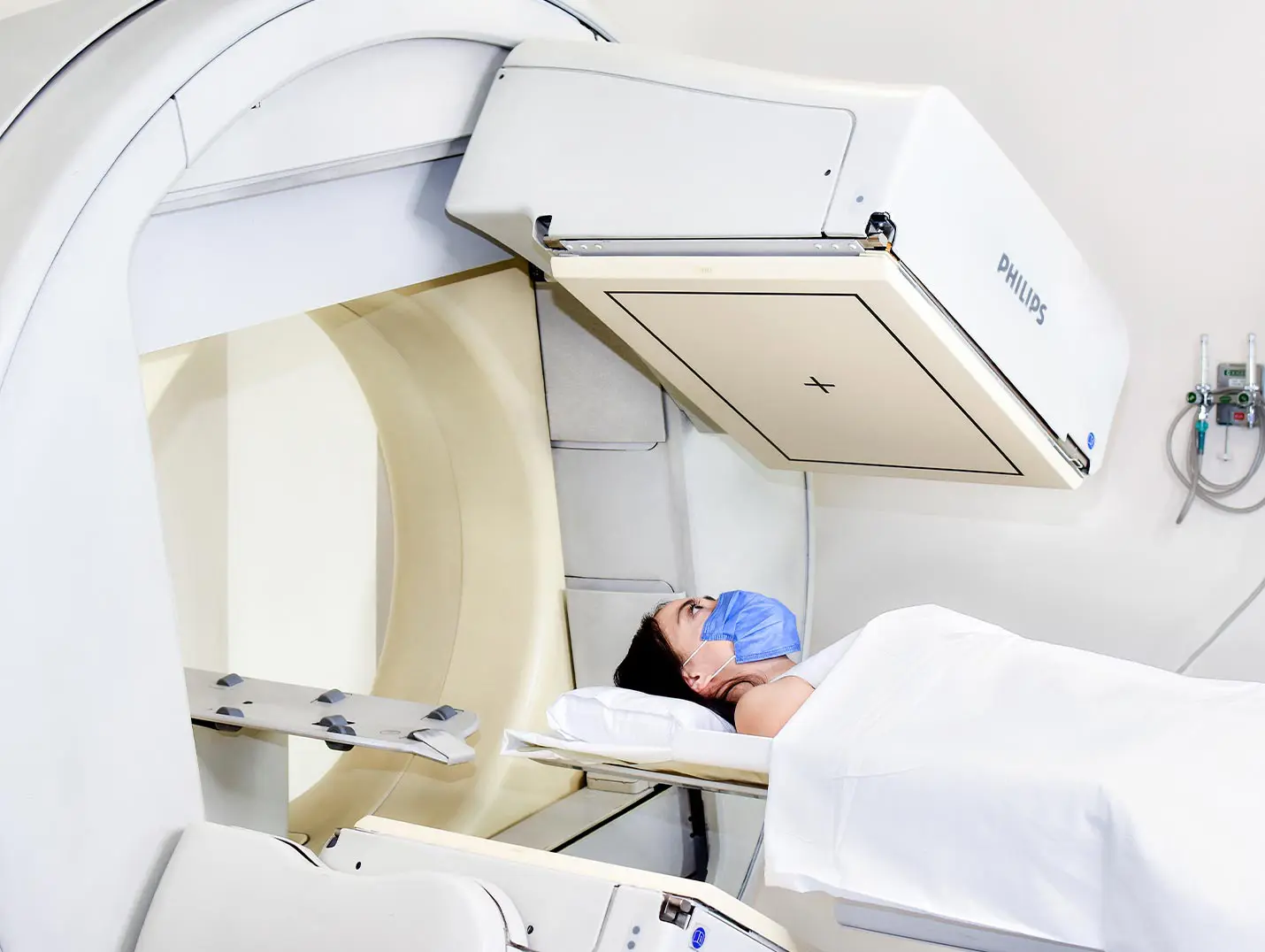
Nuclear medicine is a medical specialty primarily focused on diagnostic imaging of patients, providing information that is essential for the treatment of various conditions through the use of radioisotopes.
It involves administering a radioactive isotope via various routes to observe its distribution within the body; these routes may include oral, intravenous, inhalation, or intracavitary (intrathecal, intra-articular, intra-abdominal, etc.), with the oral and intravenous routes being the most commonly used.
All procedures performed in nuclear medicine are noninvasive. Patient preparation and the duration of the examination will depend on the specific technique being used.
The radiation doses received by a patient undergoing a scintigraphy scan are similar to those from other diagnostic methods (X-rays and CT scans) and do not pose any particular risk to the patient.
The main types of scintigraphy performed are:
- Bone scan:used to evaluate conditions of the musculoskeletal system. This test is indicated for the detection of metabolic, traumatic, infectious, or neoplastic bone disorders.
- Pulmonary scintigraphy:This test is used to determine whether there is a blockage (blood clot) in the pulmonary arteries.
- Renal scintigraphy:This procedure provides morphological information on both kidneys and, at the same time, allows for a highly accurate assessment of the percentage of function in each kidney.
- Thyroid Scintigraphy:This test evaluates the morphological anatomy of the gland. It is used to detect residual thyroid tissue following total or partial thyroidectomy, hyperthyroidism, ectopic thyroid tissue, thyroglossal cysts, and thyroid nodules.
- Cardiac SPECT:This non-invasive test evaluates myocardial perfusion at rest and during exercise. The test can be performed in two ways: using a pre-exercise electrocardiogram (ergometry) or by intravenous infusion of a medication (dipyridamole) that simulates the effects of exercise. Once maximum exertion is achieved, the radiopharmaceutical (Methoxyisobutylisonitrile-Tc99m or Tl 201) is injected and binds to the myocardium. If a coronary artery is partially or completely occluded, less radiopharmaceutical will reach the muscle segments supplied by that artery. With this test, we can also obtain images synchronized with the patient’s electrocardiogram (gated-SPECT), allowing visualization of myocardial perfusion at different points in the cardiac cycle (systole and diastole).
- Brain SPECT: Assesses focal or diffuse abnormalities in cerebral perfusion. The most important clinical applications are: diagnosis and evaluation of cerebrovascular diseases; differential diagnosis of dementias (senile dementia, Alzheimer’s disease); and identification of the epileptic focus in partial seizures.
- Isotopic ventriculography: This test evaluates left or right ventricular function at rest by measuring ejection fraction and wall motion.
- Gallbladder scintigraphy: This test allows forthe assessment of gallbladder function and helps rule out gallbladder dyskinesia, acute cholecystitis, or chronic cholecystitis.
- Gastrointestinal Series: This test is used toevaluate gastroesophageal reflux, active gastrointestinal bleeding, and rule out Meckel’s diverticulum.
Advantages:
- Highly reproducible due to the low radiation level.
- Non-invasive.
- No side effects.
Contact:
Dr. Pedro Sixto Flores Hernández
Phone:
477 788 56 00 Ext. 2075
Location:
Ground Floor, Inpatient Tower


 Av. Cerro Gordo, Lomas Campestre, 37150 León, Guanajuato, México
  +52 477 788 5600